Saturday, September 27, 2014

Native as a Tourist

I was born and brought up in Alleppey, the home of Kerala's backwaters. How ironic would it be when I say that I had never been on a houseboat until the last week? Travelling in Kerala with a bunch of non-Malayalam speaking people was something of a different experience.

The sun hid behind the clouds to give Vembanad Lake a soft touch, a pleasure to my camera. Munnar received us with rain and mist but the sun shone pleasantly on the next morning. Kerala continues to fascinate me with its uniqueness. 


Houseboats lined up in one of the canals extending from Vembanad Lake at Kumarakom, near Alleppey.

Floating on India's longest lake!
Houseboats are luxurious versions of the traditional "Kettuvallam".  They were originally used to transport rice and spices from Kuttanad to the port in Kochi.

He passed our houseboat, probably rowing home after the day's catch

 Trying their luck with fishing.

Long exposed Vembanad Lake


Remains of the British influence in the tea estates of Munnar


The deep blue sky, the scattered clouds kissing the mountains, patches of green and the rugged mountains - a view from Top Station, Munnar. 


Top Station known for its mist cover, presented a clear frame on that day.


Saturday, May 24, 2014

The Cloud Paintings of Gokarna

Gokarna, situated along India’s western coast, in Uttara Kannada district of Karnataka, is all about its temples and beaches. To me, Gokarna recited poetry through its paintings in the sky. Ranging from an early morning shyness of the sun hiding behind the clouds, the heavy dark clouds preparing to weep, an outrageous dusky sky, and to the scampering clouds of the night sky, the spiritual coastal town proved to be nature’s canvas. 


"I loved weather, all weather, not just the good kind. I loved balmy days, fearsome storms, blizzards, and spring showers. And the colours! Everyday brought something to be admired: the soft feathery pattern of cirrus clouds, the deep, dark grays of thunderheads, the lacy gold and peach of early morning sunrise. The sky and its moods called to me."
- L. Jagi Lamplighter 

"So fine was the morning except for a streak of wind here and there that the sea and sky looked one fabric, as if sails were stuck high up in the sky, or clouds have dropped down into the sea."
- Virginia Woolf

"The overcast skies had the colour of deadened stones, and seemed closer than usually, as though they were phlegmatically observing my every movement with their apathetic emptily blue-less eyes;each tiny drop oh hazy rain drifting around reflected transparent molten steel, the pavement looked like it was about into disconsolate tears; even the air itself was gray, so ultimately and ubiquitous that colour was everywhere around me. Gray.. "
- Simona Panova 

"When we look up, it widens our horizons. We see what a little speck we are in the universe, so insignificant, and we all take ourselves so seriously, but in the sky there are no boundaries. No differences of caste or religion or race."
 - Julia Gregson 

"I know that I shall meet my fate somewhere among the clouds above; those that I fight I do not hate, those that I guard I do not love." - W. B. Yeats

"Clouds come floating into my life, no longer to carry rain or usher storm, but to add colour to my sunset sky."
- Rabindranath Tagore
"The first stab of love is like a sunset, a blaze of colour - oranges, pearly pinks, vibrant purples.."
- Anna Godbersen

"He stepped outside and looked up at the stars swimming in schools through the wind-driven clouds"
- John Steinbeck
"Be like a star and shine, whether people care or do not care; the clouds are temporary, but your beauty is permanent."
- M. F. Moonzajer


Thursday, January 23, 2014

Unheard, unseen, survivors - Nagaland

Packed platforms, thick jacket clad men and women with scarves around their neck and their hands in gloves and pockets – the scene at Dimapur railway station on that grey, foggy January morning. The frame that locked my eyes, while alighting from the Nagaland Express was evocative of a Classic Hollywood set. 

The picture outside the railway station, however, killed all the excitement, as it was not much distinct from that of a typical India broadcasted on Western television channels. The state of Dimapur-Kohima highway put me down doubly. Potholes after potholes would only lead to a dirt track and we were warned not to expect anything better until we closed in on the capital.

The car moved through a zigzag road cut through mountains, rather slowly, leaving behind several terraced pineapple farms and jawans of the Indian Army standing guard at regular intervals. “That is routine in the northeast,” informed Ketho, a good friend and the one who helped materialize a long pending trip to Nagaland.

Waking up to bliss!
The rays penetrating through the trees on a private estate at Medziphema. It is a township on the Dimapur-Kohima highway  and was formerly known as ''Ghaspani'' which literally means ''water from the plant/tree''.

Medziphema, an agrarian town a little off the highway, was our halt en route to Kohima. The Meyase’s, our hosts in Nagaland owned a beautiful estate in the town. Ketho was the youngest of their four. We were welcomed with milky, light-flavoured tea, and biscuits, besides a perfect seat to relish the warmth of burning firewood. This turned out to be what I would describe as a “perfect Naga morning” during the course of our expedition.

Milky, lite flavoured tea, biscuits and the fire - a perfect Naga winter morning!

Lunch followed; a curry with fresh mushrooms, unskinned chicken cooked in hot stock, smoked pork with beans, steamed vegetables, and red rice. That was just the beginning of Naga hospitality, the extravagant food served wherever, and whomever we visited. Nagas are also maestros of preserving food and their pickles are pungent but addictive. 
The capital Kohima on a misty morning, waking up to the eagerly awaited sun rays.


Faculty quarters of the Science college, Jotsoma, Kohima.
The Christmas flowers on the top right of the image is a rich ingredient to the tone of this beautiful hill station.

A large chunk of Naga population inhabits parts of Manipur, Assam and present day Myanmar, an outcome of the national government’s insensitive boundary demarcations. I could feel their resentment against the state on many instances. Prior to befriending a handful of Nagas and others from the northeast, all I had heard about that part of the country were the Naga militants and the ULFA. 

However, the ground realities are poles apart from their picture painted before mainland India. It narrates the story of a world war, oppression by the state, and strong Naga nationalist sentiment. Their 21st century transformation, nonetheless, from a tribal economy less than 100 years ago to some of the most civilized people in the country today, is astounding. 

"Naga's are not Indias; their territory is not a part of the Indian Union. We shall uphold and defend this unique truth at all costs and always"- Khrisanisa Seyie,
First President, Federal Government of Nagaland.
(12th July 1956 - 18th February 1959)


Khonoma Village
The Meyase’s belonged to the Angami tribe and were natives of Khonoma, India’s first green village. Vegetated hills hide Khonoma from the rest of world, a natural barrier against enemy threats in the days of tribal confrontations.

The hamlet’s dwellings with sloping roofs, smoke puffing out of their chimneys, narrow cobble stone tracks crisscrossing the streets, delightful Christmas flowers blooming ubiquitously and the village church on top of a hill was reminiscent of an Italian countryside portrayed in several travelogues. A sizeable mountain slope terraced with shades of green, yellow, and brown provided their subsistence. As in Khonoma, terrace cultivation together with slash and burn agriculture are the most common agricultural practices in Nagaland.


Terrace cultivation at Khonoma village.


Dzulekie stream flowing down from the waterfall.

Dzulekie, known for its cave waterfalls, needs sturdy feet for exploration. The area surrounded by sub-tropical forests has a stream that flows from a sleek and narrow gorge, seeping underground at some spots. Estimating strides over slippery rocks along the stream, I misjudged a mossy boulder and there I was skidding down, one hand grabbing my camera. Yet, value for the spectacle at the end of the stream where it joins another cascade.    
One of the waterfalls at Dzulekie.

A closer view of a waterfall at Dzulekie shot using long exposure.


Winter skyline


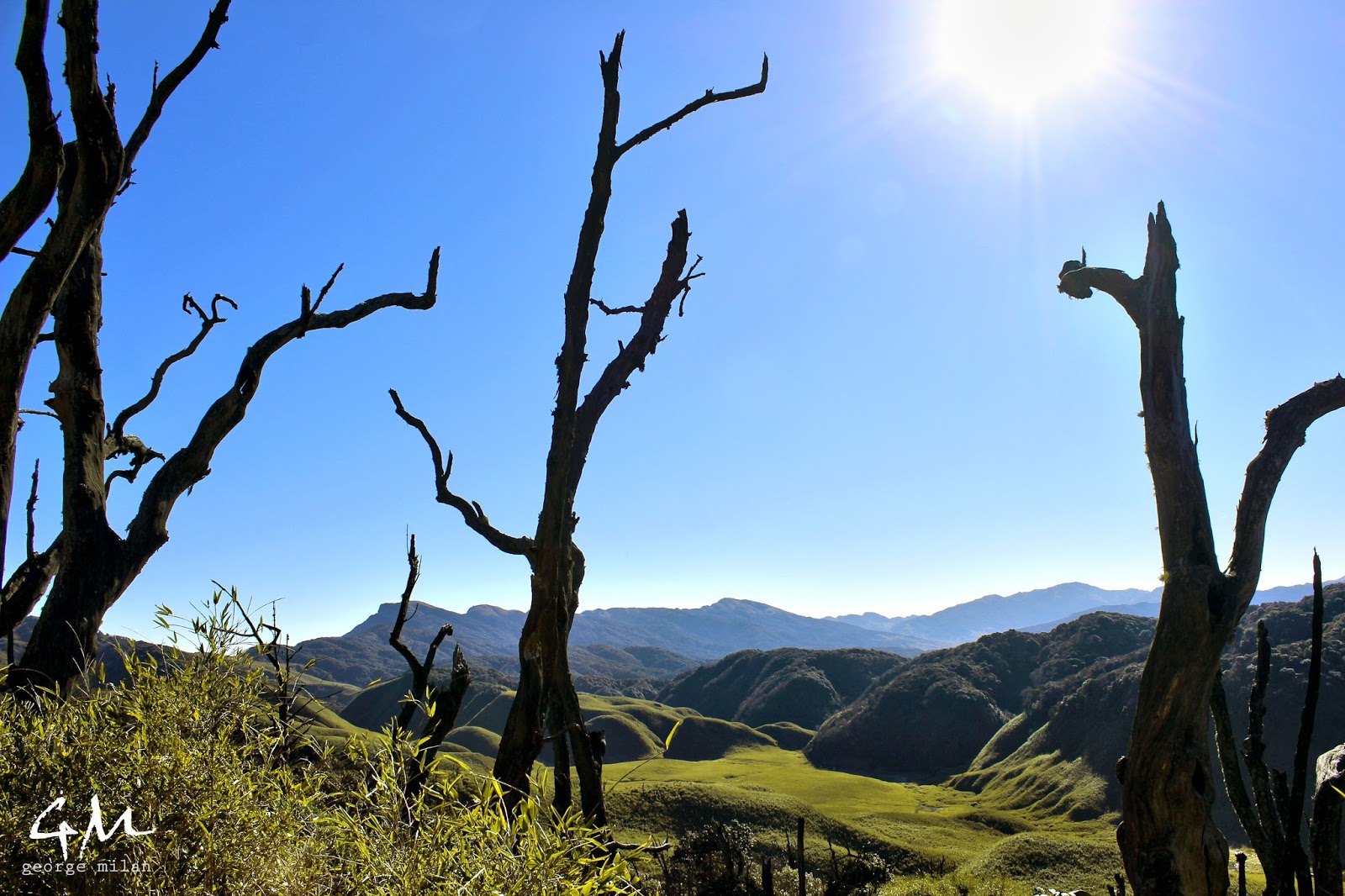
Dzukou valley was worth the two-hour trek, the first half hour of which left me gasping, owing to the angle of ascend and gelid weather. The valley is an enchanting green folded landscape at 2438 metres above sea level, situated at the border of Manipur and Nagaland. 

First glimpse of  the Western Dzukou.


A day in Paradise.
Western Dzukou is visited in winter while the Southern Dzukou is preferred during summer when the valley would be covered with seasonal flowers.


The frozen stream at Dzuko Valley
Dzukou derives it's name from the Angami/Mao word which means 'cold water'.
Interestingly, there are age-old footprints of wild elephants in the valley, and the animals are not to be seen any longer.


Kohima, the capital.

A typical Naga kitchen durings winters.
This was one noticeable common thing in all the houses I visited. Water being heated using firewood throughout the day, different herbal roots (some close to the spring onion family) hanging above the fire along with dried pork fat.


Fighting the winter.
In an attempt to keep himself warm, the shopkeeper is trying to get the coal burning by swinging the 'chula'.


Kohima's streets turn into vegetable and fish markets as the day progresses and edges closer to sunset. They also commonly sell a kind of fresh water clam. 

A moonlit Kohima town shot from Jotsoma Village.


Where bravery sleeps.
The World War II Cemetery at Kohima is dedicated to 10000 Allied soldiers who lost their lives during the Japanese invasion. The Battle of Kohima was fought between the Japanese and British and lasted for nearly three months between April and June 1944. The site used to be a tennis court of the Deputy Commissioner and one of the fiercest battles was fought here. Towards the left of the cross in the image is a cherry tree which was used as a Sniper's post and marks the limit of the Japanese advance into India.

The final shot from Nagaland; sunset as seen from Dimapur railway station. 

Leaving the land of these “survivors” (as Ketho refers to his people) would not have been a choice if I had an option. Attendance is a high priority issue in academic life. Ten days were too less a time to explore this alluring northeastern state and returning is inevitable.  

The Nagas are by far the most hospitable people I have come across in life - a God fearing, hard working populace living rooted to their traditions.

So long. 


Monday, December 30, 2013

Shades of Life

Majority of us are lucky to be born with possibly everything we could ask for but we are seldom grateful about the blessing bestowed upon us. On the other hand, there exists a lot of  people who find it difficult to meet both ends daily. I wonder how many of us take a moment of our 'busy' lives to think how these less fortunate fellow beings make it through a day, let alone lending them a helping hand. 


I was clicking the cooking corn while my friend was buying a corn from this woman. A seemingly drunken man sitting little away from her insisted that I click "ma's" picture. He appeared too old to be her son though! The moment I had the camera at her, she pulled the loose end of the sari over her head and gave me this look - narrating a story of distress at old age. 
A shot from Guwahati, Assam.

A velichappadu is considered to be the mediator between deities and devotees. He performs what is known as the velichappadu nirtham on special occasions. This photograph was captured on the occasion of Ayyapan Vilaku associated with the Sabarimala pilgrimage. 

I happened to see this old woman outside a school gate and observed her for a while. Here, she is not begging for alms but doing her trade with school children. She's such an inspiration, trying to earn a living even at this age, against all the odds. Her determination and willpower held me to the scene. Those hands coming out through gaps in the school gate seemed quite intriguing as well. The scene spoke a lot about old age, poverty, freedoms and the lack of it.
A photograph from the IT hub of Hyderabad.

A spice vendor from Old city, Hyderabad.
He did not speak anything but just nodded to my request for a photo. I could hardly notice any change in his static expression even when i showed him the photograph. 

Lives that pass by; some of them spare that moment to take a look at you while the rest are all preoccupied. Here are two unknown actors from our daily life.

I caught this woman all alone in the distance, shooting from Kerala's second longest river Bharathapuzha. It looked odd as she stood there in the same posture for a long long time, occasionally making gestures to someone invisible.

Green green guavas.
The guavas and the seller all in green attracted me to take this shot at Old city, Hyderabad

Autowala
We rarely remember the faces of cab drivers who gave us a ride. This one is for them. 

A woodcutter trying hard to remove trees that fell across a road due to strong winds. A photograph from the high ranges of Kerala.

The toddy collector.
Toddy is the drawn sap of coconut trees or toddy palms used as a local substitute for alcohol.  The photograph shows a toddy collector who collects the sap and delivers it to toddy shops. 

An old man walking past and glancing at the rising structures of  DLF Cyber City, Hyderabad.
It could be another story of India's ever growing corporate culture taking away the simple and peaceful life of the less fortunate citizens in this country.

Yet another example of hard work and determination to earn ones living at old age.  She was selling cucumbers and mangoes at Auro beach, Pondicherry, walking tirelessly, two and fro, refusing to give up even in that midday heat. The huge nose rings and earrings would probably narrate a different story about her past. 


Sunday, November 10, 2013

Old City's Splendor

Hyderabad's Old city is known for its history and its wonderful people. The crowded markets, the fragrance of the Persian perfumes and the classic Hydrabadi food that tickles your taste buds gives you a whole new experience. 

Crowd city!
 Old city, Hyderabad

A vendor's collection

This should be the most beautiful footwear shop! 

Jingle Bangles
Old City's exclusive collection for you. 

Lights everywhere; one of Old City's night markets.

The perfect street!

The iconic Charminar

Eyes down
A Muslim family from Old City.